


Free Things to Do in Atlanta (That Actually Feel Like You’re “Doing” Atlanta)
Atlanta is one of those cities where the best moments often happen between the ticketed attractions. You can spend money here easily, sure—but you can also build a full, deeply “Atlanta” itinerary for the price of a coffee, especially if you lean into the city’s best strengths: parks stitched into neighborhoods, public art that changes weekly, history that lives on the street level, and a local culture that treats walking trails like social boulevards.
This guide is designed for travelers who want real experiences without constantly calculating the cost. Some ideas are “free all the time,” others are “free on specific days,” and a few are “free if you plan the logistics right.” The goal isn’t to squeeze every penny; it’s to leave with the feeling that you understood Atlanta—its rhythm, its stories, its views, and the way it opens up when you slow down.
Free Things to Do in Atlanta – Index
- 1. How to Do Atlanta for Free Without Feeling “Cheap”
- 2. Walk the Atlanta BeltLine Like a Local
- 3. Piedmont Park: The Skyline Picnic You’ll Remember
- 4. Historic Fourth Ward Park and the Old Fourth Ward Stroll
- 5. Downtown Without a Ticket: Centennial Olympic Park and Surroundings
- 6. Sweet Auburn and the Martin Luther King, Jr. National Historical Park
- 7. Street Art Safari: Krog Street Tunnel and the City’s Outdoor Gallery
- 8. Always-Free Culture: Atlanta Contemporary and Smart Museum Days
- 9. Neighborhood Wanders That Cost Nothing: Inman Park, Little Five Points, and More
- 10. Free Events That Make You Feel Like You Live Here
- 11. A Perfect Free Day Itinerary in Atlanta
- 12. AIREVO Tips for Doing Atlanta on a Budget
- 13. FAQs About Free Things to Do in Atlanta
How to Do Atlanta for Free Without Feeling “Cheap”
The trick to “free Atlanta” is to treat the city like a series of connected neighborhoods rather than a checklist of attractions. You’ll get the most value from pairing one big walk with one deep, focused area—because Atlanta’s sprawl is real, and bouncing across town for small wins can eat your day in transit. If you plan your free experiences in clusters, the city suddenly feels intimate: murals lead to parks, parks lead to markets, markets lead to skyline views.
Another key is timing. Atlanta’s free experiences are often at their best in the early morning and golden hour—when the heat is softer, the light turns the city cinematic, and locals are out doing their rituals: running the trail, walking dogs, grabbing iced coffee, meeting friends on a park bench. If you match that rhythm, your day feels curated even if you never open your wallet.
Finally, accept that “free” doesn’t mean “no planning.” Some free museum days are monthly, some need reservations, and some historic sites have limited hours. If you’re flying in for a short stay, it can be worth checking flights that land at the right time so you can maximize daylight without paying for an extra night. If you’re still booking, this is a natural place to compare routes on AIREVO so your arrival lines up with your itinerary rather than fighting it.
Walk the Atlanta BeltLine Like a Local
If you only do one free thing in Atlanta, make it the BeltLine. Not because it’s famous, but because it explains the city: Atlanta is reinventing itself in public, and the BeltLine is where you can watch that transformation in real time. The Atlanta BeltLine is a 22-mile loop of trails, parks, and future transit connecting dozens of neighborhoods, and even a short walk on a popular segment gives you the sense that the city is stitched together by movement, art, and community.
The Eastside Trail is the “classic” first-timer choice because it’s established, lively, and full of visual payoff—skyline peeks, murals, food hall energy, and the kind of people-watching that makes you feel like you’ve stepped into Atlanta’s daily life. You can start at Piedmont Park and walk south toward the Old Fourth Ward, and the route naturally pulls you past places that feel like landmarks even if you never buy a thing. Discover Atlanta describes the Eastside Trail as the most established area, stretching from Piedmont Park down toward Reynoldstown, with views and street art that make the walk itself the attraction.
How to enjoy the BeltLine without spending money
You don’t need a bike rental, a guided tour, or a dining plan to have a great BeltLine day. What you need is time, comfortable shoes, and permission to move slowly. Take the trail like a gallery: stop when you see something, double back if the light is better, wander onto the side paths that lead into neighborhoods, and let the city reveal itself. The BeltLine’s own trail pages emphasize that it’s meant for everyone—walkers, cyclists, culture seekers—and that mindset matters more than any purchase.
If you love context—knowing what you’re looking at rather than just strolling past it—this is one of the few moments where a small paid add-on can upgrade a mostly free day without feeling forced. A self-guided audio experience can turn murals and landmarks into stories. For that, you can weave in an Atlanta walking audio guide from WeGoTrip right as you step onto the trail, so the city narrates itself while you keep your spending minimal.
The BeltLine’s public art: your free, ever-changing museum
One of the best things about Atlanta is that the art isn’t locked behind doors. The BeltLine is packed with murals, sculptures, and temporary installations, and the “temporary” part is the magic: repeat visits never look the same. Discover Atlanta highlights how the BeltLine offers a year-round, free art experience where murals and sculptures become part of your workout, your stroll, your commute, your date.
You’ll notice that the art isn’t just decoration. It’s commentary, celebration, memorial, and neighborhood identity. Some pieces are playful; others are heavy. The point is to stay curious. Atlanta rewards attention.
Piedmont Park: The Skyline Picnic You’ll Remember
Piedmont Park is the city’s open-air living room. It’s the place where Atlanta exhales—where joggers loop the paths, friends gather on blankets, and the skyline looks close enough to touch. The park is open daily, and the Conservancy frames it as a free resource for everyone, with hours that typically run from 6 a.m. to 11 p.m.
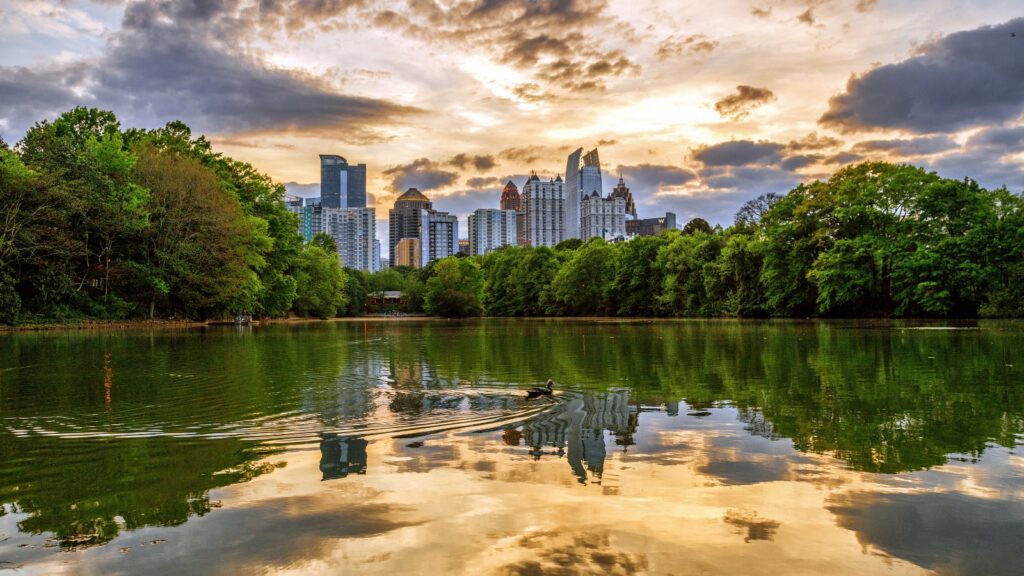
Even if you’re not “a park person,” Piedmont has a way of converting you. The most iconic moment is Lake Clara Meer, where the water reflects Midtown’s buildings and turns an ordinary afternoon into a postcard. It’s free, it’s easy, and it feels like the kind of city memory you’ll keep long after you forget what you ate.
A simple Piedmont plan that feels luxurious
Arrive late afternoon with a small picnic, claim a patch of grass where you can see the skyline, and let the city do the rest. If you’re traveling light, this is also a good day to stash your luggage rather than dragging it around—especially if you’re between check-out and a late flight. A luggage storage spot through RadicalStorage can make your “free day” feel smoother without turning it into a shopping trip.
As the light changes, the park changes. The skyline warms up, the paths get busier, and you start to understand how Atlanta socializes outdoors. It’s not a tourist scene; it’s a local habit you get to borrow.
Historic Fourth Ward Park and the Old Fourth Ward Stroll
If Piedmont is the classic skyline park, Historic Fourth Ward Park is the modern neighborhood park—built for strolling, lounging, and watching the city’s newer energy flow by. It sits right by the BeltLine and gives you a different Atlanta: less postcard, more “this is how people actually spend a weekday evening.”
The BeltLine highlights family-friendly features like playgrounds and a seasonal splash pad, which makes this an easy free stop if you’re traveling with kids—or if you just want to sit near water and reset your brain for a bit.
How to connect it into a larger free walk
This park shines as a connector. You can walk here from the BeltLine, loop the paths, then continue toward Ponce City Market area for browsing, people-watching, and rooftop skyline envy without paying for admission. Even if you never buy anything, the area feels alive—like you’ve stepped into Atlanta’s current cultural center.
Downtown Without a Ticket: Centennial Olympic Park and Surroundings
Downtown Atlanta can feel like “the place you pass through” on the way to paid attractions. But if you approach it as a walkable story—Olympics, public space, city reinvention—it becomes a genuinely fun free outing. Centennial Olympic Park is a 22-acre legacy of the 1996 Summer Olympics, and simply walking it gives you the sense of how Atlanta imagines itself on the world stage.
What makes it especially good for budget travelers is that the park encourages self-guided exploration. Discover Atlanta points visitors toward a free audio tour and “Brick Locator” concept so you can wander with purpose, connecting monuments and history at your own pace.
Making downtown feel personal instead of generic
The secret is to slow down and create a theme for your walk. Maybe it’s Olympic legacy. Maybe it’s architecture and city vibes. Maybe it’s photography—catching reflections, wide streets, and the contrast between old brick and modern glass. Downtown rewards the camera, especially in the early morning when the streets feel spacious and the light is clean.
If you want to pair downtown with one paid activity, this is one of the better zones for booking a single standout experience—like an observation, a timed attraction, or an evening event—while keeping the rest of your day free. If you’re scanning what’s available during your travel dates, Klook is a natural place to check options without committing to a whole day of tickets.
Sweet Auburn and the Martin Luther King, Jr. National Historical Park
There are cities where history is behind glass. In Atlanta, some of the most important stories live in the neighborhoods. Sweet Auburn is one of those places: you can feel the city’s civil rights legacy in the street grid, the churches, the murals, the everyday presence of memory.
The Martin Luther King, Jr. National Historical Park is one of the most meaningful free experiences in the city, and it’s explicitly free: the National Park Service notes there is no fee to enter and no entrance pass required. That matters, because it keeps this experience accessible—and it changes the energy. You’re not entering an attraction; you’re entering a place of national significance that still belongs to the city.
How to visit with respect (and deeper understanding)
Give yourself time. This isn’t a “quick stop.” Walk slowly. Read what’s posted. Let silence be part of the experience. If you want added context, a self-guided audio tour can be helpful here as well, especially if you’re the kind of traveler who likes hearing the story in sequence while you move through the site. That’s another natural moment for a WeGoTrip audio guide, used lightly, to deepen a mostly free afternoon.
Street Art Safari: Krog Street Tunnel and the City’s Outdoor Gallery
Atlanta’s street art isn’t a side quest—it’s a headline. And the best part is that some of the most iconic spots are free, public, and constantly changing. Krog Street Tunnel is the perfect example: it’s not a museum, it’s a living wall, repainted and argued over in color.
Discover Atlanta calls it what it feels like: free art, vibrant and always alive, a place that doubles as a photo backdrop and a creative pulse check. Atlas Obscura echoes the same idea—this is an always-changing tunnel where you can walk or bike through and see something different every time.
How to do Krog Street Tunnel the right way
Go in daylight, take your time, and expect the artwork to be layered—literally and culturally. Some pieces are polished, some are raw, and some are the visual equivalent of a shouted conversation. The point isn’t to judge it like a gallery; it’s to experience it like a city speaking in public.
If you want to expand your free street art day, the BeltLine itself can be your main corridor, because Discover Atlanta’s street art coverage makes it clear how murals and installations spread across trails and neighborhoods. The city becomes a map of color.
Always-Free Culture: Atlanta Contemporary and Smart Museum Days
Atlanta has a quiet superpower: some of its culture is accessible without an entry fee, not just on special occasions, but as a philosophy. Atlanta Contemporary is the clearest example. Their own visit information is straightforward: free admission every day.
That matters because it means you can treat contemporary art like a casual part of your itinerary. Pop in for 30 minutes. Leave. Come back later if the mood hits. It doesn’t have to be an “event.” It can be a texture in your day, the way it is for locals.
Free days that are worth planning around
If you’re in Atlanta on the second Sunday of the month, the High Museum of Art runs “UPS Second Sundays,” offering free admission for all visitors with family-friendly programming. This is one of those “plan around it” moments because it can turn an expensive museum day into a free cultural anchor for your trip.
There’s also a broader Georgia-wide moment that can overlap with Atlanta travel: Super Museum Sunday. Georgia State Parks describes it as a day when state historic sites offer free admission, tied to the Georgia History Festival. Explore Georgia frames it similarly as a statewide free-admission day across many museums and historic sites. If your dates line up, it’s worth checking what participating sites are closest to where you’ll be staying.
Neighborhood Wanders That Cost Nothing: Inman Park, Little Five Points, and More
A lot of “free” Atlanta is simply walking the right neighborhoods with the right mindset. Some cities are built for monumental sightseeing. Atlanta is built for character—porches, trees, murals, independent storefronts, pocket parks, and streets that shift vibe block by block.
Inman Park is a great place to wander without a plan. It’s pretty, it’s historic, and it sits near BeltLine energy, so you can pair “quiet neighborhood charm” with “urban trail culture” in the same afternoon. Little Five Points is a different flavor: more eccentric, more alternative, more the kind of place where people dress like they’re going to a concert even on a Tuesday. You don’t need to buy anything for it to be fun; the joy is in noticing the details, the window displays, the street corners that feel like tiny stages.
A photographer’s free playground: Jackson Street Bridge
If you want one classic “I was in Atlanta” photo without paying a cent, go to Jackson Street Bridge. Discover Atlanta describes it as the quintessential skyline view, and emphasizes what you care about here: standing on the bridge costs nothing, and the view is the prize.
Go at sunset if you want drama, or go at night if you want the city to glow. Just be mindful of traffic and keep your awareness up—this is a real bridge in a real city, not a fenced overlook.
Free Events That Make You Feel Like You Live Here
The best free moments in Atlanta often come from events—parades, open streets days, festivals in parks, seasonal community gatherings. The key is to avoid over-planning while still giving yourself a chance to stumble into something local.
One of the most beloved formats is the “open streets” idea, where roads temporarily become people space. Axios describes Atlanta Streets Alive as a car-free celebration that transforms a stretch of the city into a place to walk, bike, and simply exist outdoors for a few hours. Even if you don’t catch that exact event, it explains something true about Atlanta: when the city creates room for people, the culture blooms immediately.
Parks also host plenty of free or low-cost programming, and the BeltLine in particular is known for cultural happenings throughout the year. If you’re visiting during a popular weekend, it’s worth checking what’s happening near the neighborhoods you’re already exploring—so you’re not crossing town just to “find something free,” but letting free experiences come to you.
A Perfect Free Day Itinerary in Atlanta
Start your morning on the BeltLine, ideally on the Eastside Trail, when the air is cooler and the city is still stretching awake. Let the public art set your pace—stop often, take photos, watch cyclists glide by, and notice how the trail feels like a moving community room.
From there, drift toward Piedmont Park for a mid-morning reset. Walk the lake, find the skyline angle that feels unreal, and give yourself time to sit without scrolling. If you’re traveling with a full day between accommodations, this is where it’s smartest to store your bag so the day stays effortless—RadicalStorage fits naturally here because it’s a practical fix, not a forced upsell.
In the afternoon, choose one history-and-culture anchor. Either go to Sweet Auburn and spend meaningful time at the Martin Luther King, Jr. National Historical Park, which is free to enter, or head to Atlanta Contemporary for always-free modern art that can be as quick or as immersive as you want.
End your day with a street art finale at Krog Street Tunnel, then catch golden hour from Jackson Street Bridge if you want the skyline memory burned into your camera roll. Both are the kind of free experiences that feel like you discovered something—even though they’re iconic.
If you want a small, optional paid add-on that amplifies this whole day without changing its budget nature, a self-guided audio tour can stitch the city into a story as you walk. That’s the most organic moment to consider WeGoTrip: not as a sales pitch, but as a way to turn a free itinerary into a narrated experience.
AIREVO Tips for Doing Atlanta on a Budget
Atlanta rewards travelers who travel like locals: slower, neighborhood-first, and timed around light and weather. If you build your day around one long walk and one focused district, you’ll feel like you did more—even if you spent less—because the city’s best textures reveal themselves when you’re not rushing between far-apart attractions.
Always check the calendar for the “free-but-timed” opportunities. Monthly free museum days can turn a pricey cultural stop into a highlight, and statewide free-admission events like Super Museum Sunday can unexpectedly open doors—especially if your trip overlaps with early February.
If you’re arriving for a short visit, your biggest budget leak is usually logistics, not entertainment. Plan where you’ll walk, where you’ll rest, and what you’ll do with your luggage between check-out and your departure. Solving that one friction point can make the entire day feel premium, because you’re moving through Atlanta unburdened instead of managing your stuff.
Finally, treat “free” as an invitation to go deeper, not just cheaper. When you’re not rushing to “get your money’s worth,” you can give places the time they deserve—especially the sites tied to Atlanta’s civil rights history. That’s where the city stops being a destination and starts being a story.
If you want to round out your itinerary beyond the $0 highlights, AIREVO also has a full guide to Things to Do in Atlanta. It’s perfect for mixing in one or two “worth it” experiences—like a standout neighborhood food crawl or a timed museum visit—while keeping most of your trip anchored in parks, street art, and history.
And if you’re planning a bigger USA itinerary, you can keep the same budget-smart approach city to city. Start with our picks for free things to do in Chicago, free things to do in New Orleans and free things to do in Las Vegas. Each city has its own version of “free magic,” and pairing them makes for a trip that feels rich without the constant ticket line.
FAQs About Free Things to Do in Atlanta
Is the Atlanta BeltLine free to walk?
Yes—walking the Atlanta BeltLine is completely free. It’s a public network of multi-use trails and parks, so you can hop on for a quick stroll or spend hours exploring neighborhoods, public art, and green spaces without paying anything. The only time you’d spend money is if you choose add-ons like bike rentals, food stops, or paid events nearby.
What’s the best free park for skyline views in Atlanta?
Piedmont Park is the easiest “wow” for skyline views, especially around Lake Clara Meer where Midtown reflects on the water and the skyline feels close. For a more modern, local vibe, Historic Fourth Ward Park is another great option—less classic postcard, more BeltLine energy and people-watching.
Is the Martin Luther King, Jr. National Historical Park free?
Yes, it’s free to visit. Because it’s run by the National Park Service, there’s no entrance fee, which makes it one of Atlanta’s most meaningful (and accessible) experiences. Give yourself enough time to walk slowly, read exhibits, and take in the atmosphere—this isn’t the kind of place you want to rush.
Where can I see free street art in Atlanta?
Krog Street Tunnel is the most iconic spot, and it’s constantly changing—think of it like a living, outdoor canvas. You’ll also see loads of murals and installations along the Atlanta BeltLine, especially on the Eastside Trail, where art and city life blend together as you walk.
Does Atlanta have any always-free museums?
Yes—Atlanta Contemporary is free every day, which is rare for a city of this size. It’s perfect if you want to add culture without committing to a big, expensive museum day. You can pop in for a short visit or spend longer if an exhibition grabs you.
Are there any free museum days in Atlanta?
There are. The best-known is the High Museum of Art’s “UPS Second Sundays,” which offers free admission on the second Sunday of each month. It’s a smart way to build a higher-end cultural stop into your itinerary without the usual ticket price—just expect bigger crowds than on a normal day.
What’s a free, iconic photo spot in Atlanta?
Jackson Street Bridge is the classic skyline photo location—many of the “Atlanta skyline” shots you’ve seen online were taken from here. Sunset and early evening are the most dramatic times, but even midday can work if the sky is clear. Just stay aware of traffic and be respectful, since it’s a working bridge, not a dedicated overlook.
Do not miss our newest articles!

All Rights Reserved.
Made with 🧡 by Marc Guerrero.
Made with 🧡 by Marc Guerrero. All Rights Reserved | Affiliate Disclosure | Cookies Policy | Legal Notice | Privacy Policy | Terms & Conditions